3SAE Laser Processing Station (LPS)
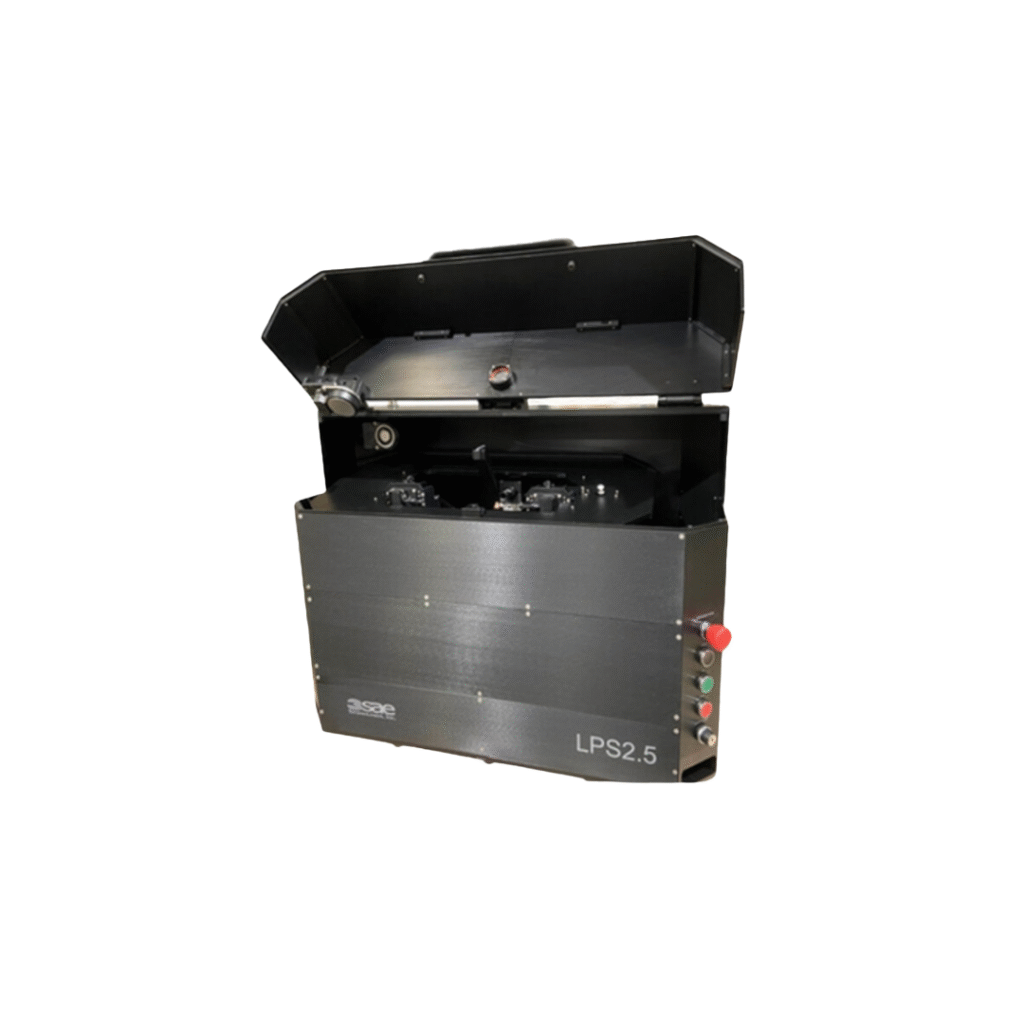
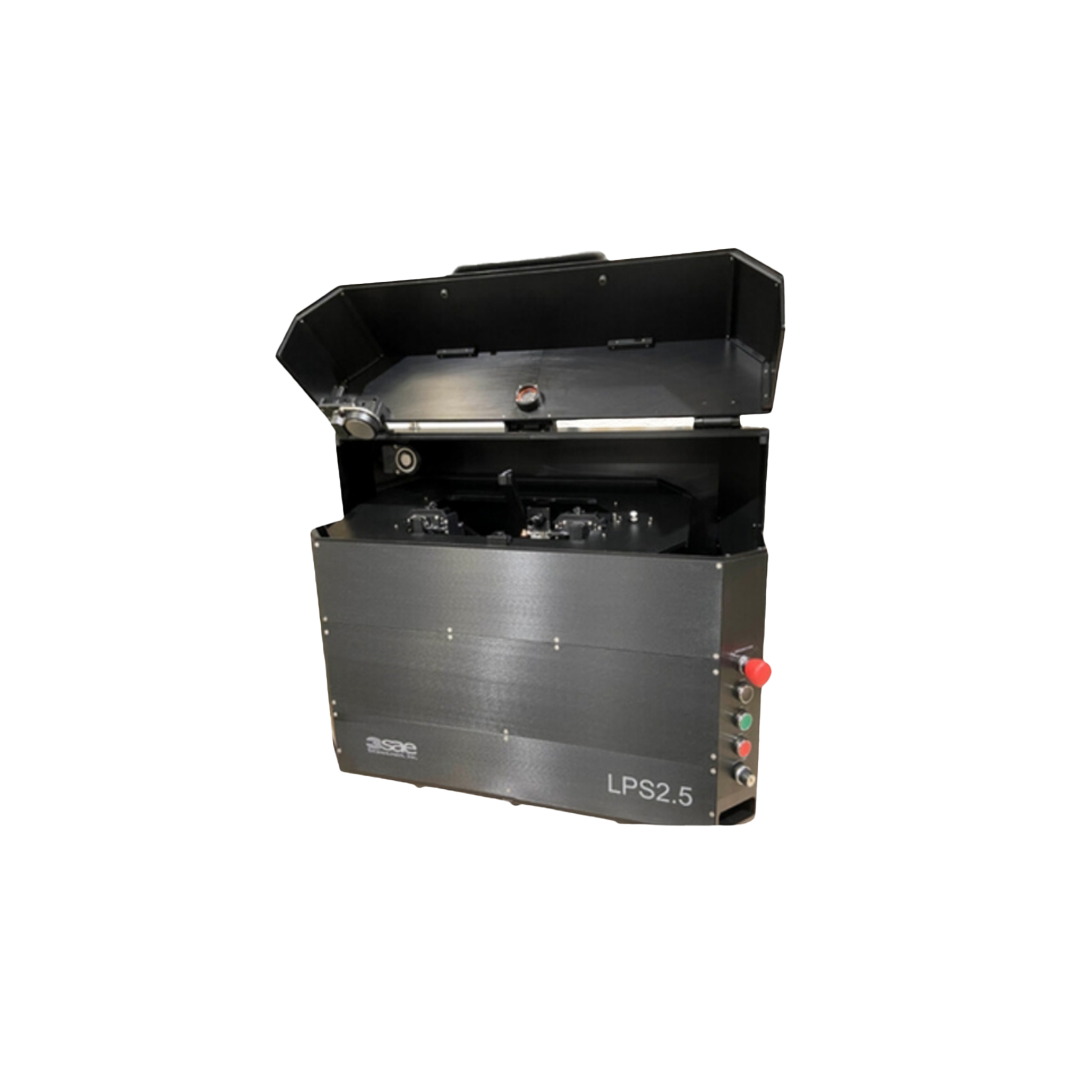
The Laser Processing Station (LPS 2.5) is an optical fiber glass processing system designed to remove cladding light, also referred to as cladding modes, by creating a series of ablations along the optical fibers’ cladding utilizing a CO₂ Laser.
The LPS 2.5 features 360 degrees of fiber rotation thereby providing the capability of ablating the fiber at any specified theta location over a length of 120mm. It supports cladding diameters from 80 microns to 1 millimeter in diameter. The LPS 2.5 is used primarily for mode stripping or removing light from the cladding of optical fibers for the purposes of manufacturing high power laser systems but is not limited to high power applications.
Ablations are small notches or etches that act as deformities in the optical fibers’ cladding through which light can be directed outward (away from the fiber) in a controlled manner based on the number of etches, etch periods, and etch depths. In addition, these ablations can increase in depth or maintain the same depth and increase in spatial lengths (periods) to scatter the light over the total etch window in an increasing or decreasing manner. The LPS 2.5 can also ablate or etch the cladding at any theta position perpendicular to the axis of the fiber.
All program parameters are controlled through a production-friendly user interface that allows for ease of use. The LPS 2.5 provides a faster and safer method for removing cladding light unlike traditional methods that require the use of hydrofluoric acid. The LPS 2.5 utilizes vision to quantify the result by scanning the outside diameter, OD of the optical fiber post etching process.
The LPS 2.5 is designed for R&D and production environments which is evident in the simplistic streamlined design, simplified GUI (graphical user interface), proven electronics, and redundant electrical and mechanical safeties.
- Class 1 10-watt CO₂ laser module including beam pointing and focusing optics
- Class 1 laser safety enclosure and sensor technology
- Features an RFID (Radio Frequency Identification) activated magnetic door lock that provides a holding force of 500 newton or 112 pounds to access door
- RFID, Laser power, laser shutter, and E-Stop are monitored and controlled within the LPS 2.5 control firmware and software
- The safety controller monitors in real time all safety states and automatically disables beam delivery when unsafe conditions are detected
- Programmable etch parameters: Control laser power, etch depth, pitch, length and overall etch profile
- The LPS 2.5 software package includes both engineer and operator specific access
- The engineer has full control over recipe development and all parameters related to the ablation process while the operator has a simplified user interface with minimal control
- Ablation positioning in the “Z” axis with increasing etch spacing control that can be utilized to control power distribution over the length of the etched window
- Ablation positioning in the “Z” axis with increasing etch depth control that can be utilized to provide power distribution over the length of the etched window. 360° of fiber rotation
- Automated fiber ablation at any fiber theta orientation
- Supports fiber etching by traversing the CO₂ laser’s beam across the fiber on a fixed axis
- Fiber fixturing is facilitated by leveraging standard 3SAE Combiner Manufacturing Station (CMS) fiber holders which are available in both standard and custom sizes
- High resolution 2 orthogonal 5MP cameras and telecentric lenses
- Adjustable weight mechanism to provide desired fiber tension during the etch process up to 1kg of force
- Built-in etch profile metrology analysis function (fiber scan) providing pre and post process feedback in graphical format
- Data includes fiber diameter, etch depth, etch pitch etch count and process fiber length
- The scanning function can be automatically or manually run at any theta position
- Automated 4-axes fiber positioning in X/Y/Z/Theta
- Automated vision focus
- Automated positional calibration routine
- Automated fiber alignment routine
- Automatic laser power control
- High performance stand-alone computing
- Up to 120mm fiber ablation processing window
- Up to 1000μm fiber clad diameter
Related links
Solutions That Covers the Entire Production Cycle
Paulsson, Inc.
Paulsson, Inc., a seismic monitoring leader, partnered with NorthLab Photonics to implement the NORIA system, enabling precise in-house production of custom Fiber Bragg Gratings for advanced fiber sensing.
Vrije University of Amsterdam
A 2017 Vrije University article highlights NorthLab’s Laser Delivery System, which rounds cleaved fiber tips to improve photoresist adhesion and enhance photonic component reliability.
GlucoSet
GlucoSet, a developer of fiber-optic glucose sensors for critical care, collaborated with NorthLab Photonics to improve precision cleaving and splicing, resulting in efficient, medical-grade sensor production.